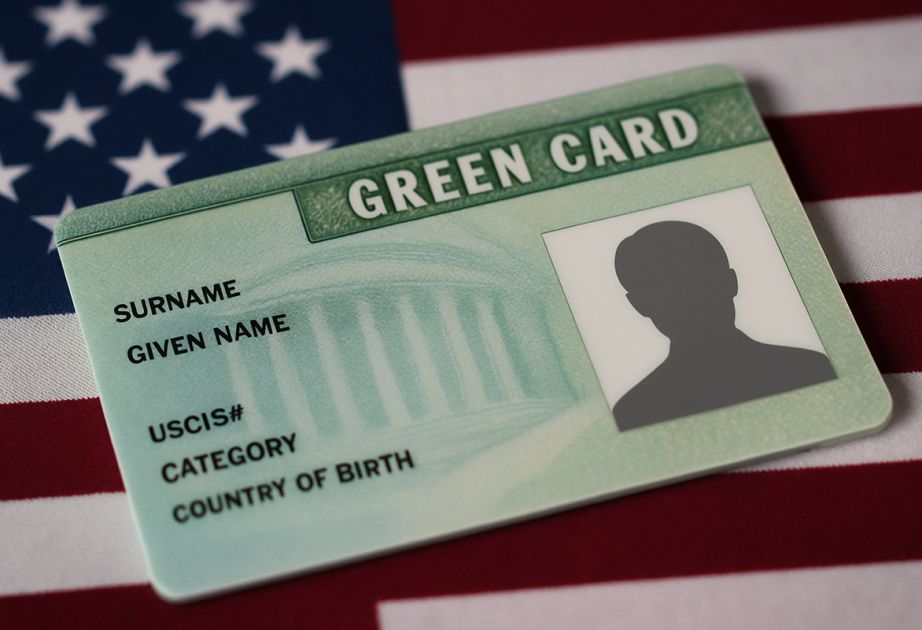
Marrying a U.S. citizen can create a pathway to lawful permanent residence, but it does not automatically grant a Green Card. Foreign spouses must complete the required immigration process, meet eligibility requirements, and obtain approval before becoming lawful permanent residents.
Understanding how marriage-based immigration works can help couples prepare the correct documents, avoid common mistakes, and make informed decisions about their future in the United States.
How does a marriage-based Green Card work?
A marriage-based Green Card allows an eligible foreign national to become a lawful permanent resident through a qualifying marriage to a U.S. citizen.
The process generally begins when the U.S. citizen spouse files Form I-130, Petition for Alien Relative, with U.S. Citizenship and Immigration Services (USCIS). This establishes the claimed qualifying relationship, but approval of the petition alone does not grant permanent residence.
The foreign spouse must also complete the applicable immigration process, which depends on where they live and their individual circumstances.
Applying for a Green Card: two main pathways
- Consular processing
Spouses living outside the United States generally pursue an immigrant visa through consular processing after the I-130 petition is approved. The process typically involves the National Visa Centre and the U.S. Department of State.
Applicants may need to submit civil documents, complete an immigrant visa application, meet financial sponsorship requirements, undergo a medical examination, and attend an interview. If approved and admitted to the United States as a permanent resident, the spouse obtains lawful permanent resident status.
- Adjustment of status
Certain spouses already in the United States may qualify to apply for permanent residence by filing Form I-485, Application to Register Permanent Residence or Adjust Status. Some eligible applicants may file Forms I-130 and I-485 concurrently.
However, eligibility depends on the applicant’s immigration history and other legal factors. A previous visa overstay, entry without inspection, removal order, or other inadmissibility issue may affect the available options. Marriage to a U.S. citizen does not automatically resolve every immigration problem.
Proving your marriage is genuine
U.S. immigration authorities assess whether a marriage is legally valid and entered into in good faith, rather than solely to obtain an immigration benefit.
Depending on the circumstances, evidence may include:
- Joint bank statements or financial records.
- A shared lease, mortgage, or residential documents.
- Photographs and travel records showing time spent together.
- Evidence of shared household responsibilities or insurance.
- Other records demonstrating the relationship.
Every couple’s circumstances are different, particularly when spouses live in separate countries. Applicants should provide truthful, consistent information and genuine supporting documents. Marriage fraud can carry serious legal consequences.
Financial sponsorship and conditional Green Cards
Most marriage-based immigration cases require the U.S. citizen petitioner to submit Form I-864, Affidavit of Support, demonstrating compliance with applicable financial sponsorship requirements. A qualifying joint sponsor may sometimes help if the petitioner does not meet the requirements independently.
Some spouses receive a two-year conditional Green Card if they have been married for less than two years when permanent residence is granted. These residents generally must file Form I-751, Petition to Remove Conditions on Residence, during the 90-day period before their conditional status expires. Certain exceptions to joint filing may apply.
Applicants should understand these obligations and follow the relevant filing instructions to avoid complications.
Common mistakes to avoid
When applying for a marriage-based Green Card, couples should avoid:
- Assuming marriage automatically grants permanent residence.
- Confusing I-130 approval with Green Card approval.
- Submitting incomplete, inconsistent, or inaccurate documents.
- Overlooking previous immigration violations or potential inadmissibility issues.
- Ignoring conditional residence filing deadlines.
- Assuming that a pending application automatically authorizes employment or international travel.
Careful preparation can help applicants identify potential issues before filing.
When should you seek legal guidance?
Consider consulting a qualified U.S. immigration attorney if your case involves a previous visa overstay, entry without inspection, removal proceedings, a criminal history, a complicated immigration record, or a request for evidence or denial.
Legal guidance can help you understand the requirements relevant to your circumstances and assess the available options before taking the next step.
Understand your immigration options
Marriage to a U.S. citizen can provide a pathway to a Green Card, but permanent residence is not automatic. Applicants must satisfy the applicable requirements, complete the correct process, and receive the necessary approval.
Sources & Further Reading
- U.S. Department of State — Immigrant Visa for a Spouse of a U.S. Citizen (IR1 or CR1)
https://travel.state.gov/content/travel/en/us-visas/immigrate/family-immigration/immigrant-visa-for-spouse.html - U.S. Citizenship and Immigration Services (USCIS) — Form I-130, Petition for Alien Relative
https://www.uscis.gov/i-130 - USCIS — Form I-485, Application to Register Permanent Residence or Adjust Status
https://www.uscis.gov/i-485 - USCIS — Form I-864, Affidavit of Support
https://www.uscis.gov/i-864 - USCIS — Form I-751, Petition to Remove Conditions on Residence
https://www.uscis.gov/i-751 - USCIS — Family of U.S. Citizens
https://www.uscis.gov/family/family-of-us-citizens
Related Articles


Latest Insights
- Kenya Class C work permit: Requirements, fees and how to apply

- Marriage to a U.S. Citizen: Why you don’t automatically get a Green Card
- Can a child lose their U.S. Green Card after staying abroad for over a year?

- American Immigration Update: DHS proposes $70,000 initial fee for F-1 student Optional Practical Training (OPT)

- Deportation in Kenya: Understanding Your Right to Due Process